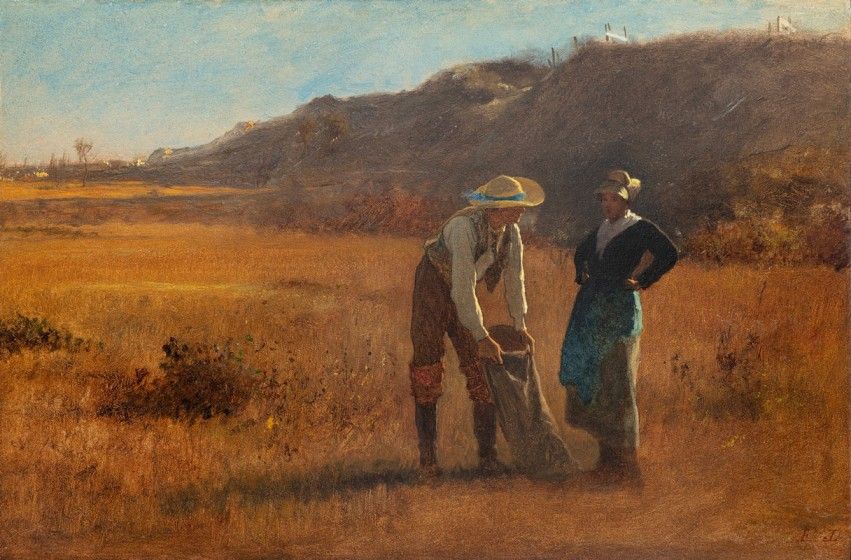
Between the Civil War and the end of Reconstruction, American artists Winslow Homer (1836-1910) and Eastman Johnson (1824-1906) created paintings of women unlike anything produced in previous decades. This major exhibition brings together for the first time an extraordinary group of more than 70 works focusing on female subjects by the two artists that make visible a consequential historic moment in American history—one that has not been fully examined by historians and is almost imperceptible in the present day. The images also reveal a complicated relationship, sometimes even a rivalry, between Homer and Johnson, two of the most well-known painters of the period.
For about 15 years, from approximately 1865 to 1880, women were thrust into a crucible of major cultural, social, and economic changes. For northern white women, their successes with Abolition fed the development of a full-blown women’s rights movement that offered them the promise of higher education, the ability to choose their own vocation, and even the right to the vote. Reconstruction and the creation of the Freedmen’s Bureaus in the South offered Black women emergent citizenship, education, and the power to control their own lives. For a brief, unprecedented moment, women gained a sense of independence and optimism for the future, seizing new opportunities and creating their own destinies. However, these dreams and new possibilities faded quickly with the failure of Reconstruction and the unravelling of the nascent women’s rights movement in the 1870s.
Homer and Johnson watched these events unfold and registered how each other’s paintings responded to these hotly debated topics. Pushed by competition and ambition, they created images of women in new circumstances and settings. Rather than passively inhabiting a landscape or decorating an interior scene, as they were typically depicted at the time, female figures began to dominate the canvases. Even when not the sole focus of the image, women are shown organizing, directing, and occasionally confronting the figures around them. These women are reading, thinking, and problem-solving. Homer’s women especially defy conventions, conquer mountains, withstand the elements, ride horses, and beat men at games of croquet. The appearance of these figures, both Black and white, coincides with a remarkable and fleeting moment in our nation’s history when a series of opportunities and promises were offered to women and then withdrawn. They also chart two decades worth of artistic interchange between Homer and Johnson, uncovering how much each man owed to the other over the course of their artistic evolution.
Co-organized by the Nantucket Historical Association and Brandywine Museum of Art, the exhibition is curated by Anne Classen Knutson, consulting curator at the Nantucket Historical Association, with the assistance of Amanda C. Burdan, Senior Curator at the Brandywine Museum of Art. The exhibition will be accompanied by a fully illustrated catalogue with essays by Knutson, Burdan, and other notable American art historians.