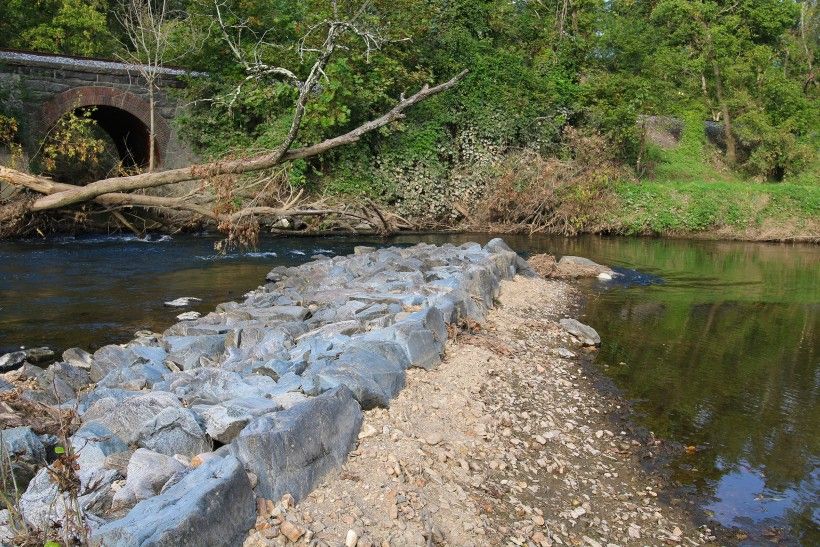
The removal of the Hoffman’s Mill dam from the Brandywine Creek has begun. This project will restore a free-flowing stretch of the Creek after more than a century.
Temporary trail closures during removal
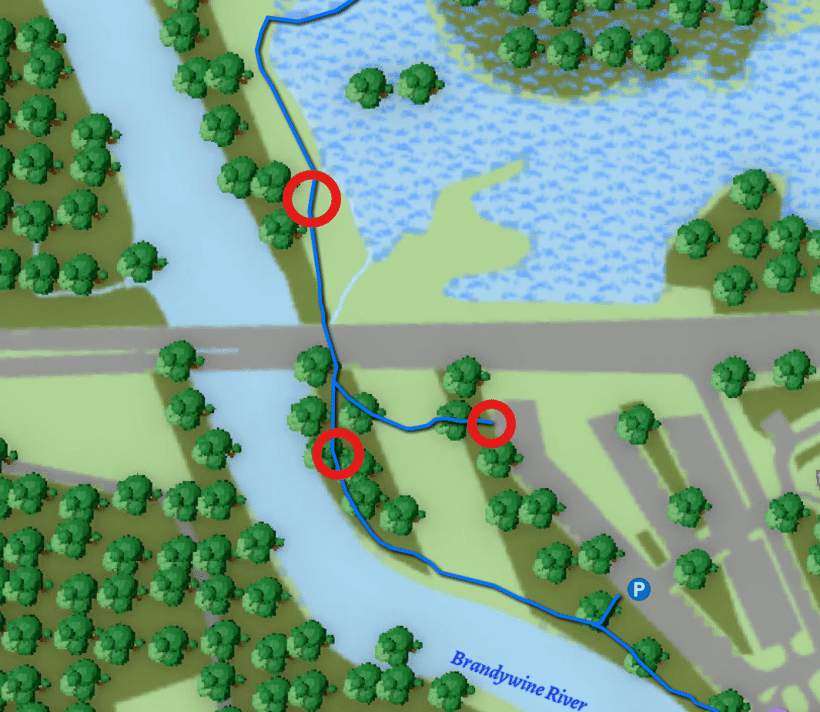
During the removal of the dam, happening now through mid-October 2026, a few portions of the Brandywine's campus River Trail will be closed to the public and canoe/kayak access will not be available. Please see the map below for the location of the trail closures. We appreciate your patience during this time!
A dam that outlived its purpose
Built in the late 19th century, the dam originally powered Hoffman’s Mill—which is now part of the Brandywine Museum of Art. The dam diverted water into a mill race that turned the mill’s water wheel, which was in active use until the mid-20th century. Today the dam serves no function and is already breached on its western side.
Why remove it
Low head dams that no longer serve a purpose pose risks to people and harm the Creek.
- Safety: Dams are a hazard to paddlers, tubers, and anyone exploring the Creek on foot.
- Recreation: Paddlers must currently carry their boats around the dam to continue downstream.
- Habitat: The dam blocks fish migration, warms the water behind it, and lowers oxygen levels. Trapped sediment also buries important riverine habitat areas known as riffles (the shallow, fast-moving sections of a stream where aquatic life thrives).
- Flooding: With no real storage reservoir, low head dams can also trap debris carried by floodwaters and worsen flooding alongside and upstream of the dam's location.
Project goals
Removing the dam advances three of the Conservancy’s ongoing efforts:
- Improve safe, recreational access to the Brandywine Creek
- Lessen flooding in the Chadds Ford area
- Support a regional effort to help American Shad migrate up the Brandywine Creek to spawn, a journey that has been blocked since the first dams went up in Wilmington, Delaware, in the early 1700s
Timeline
The project has been nearly six years in the making.
- 2020: The Conservancy begins evaluating dam removal and concludes moving forward would be a net benefit to its mission and other key objectives.
- 2020–2024: Funding secured; Ramboll selected as engineering consultant through competitive bidding process.
- 2024–2026: Ramboll completes design and, with Brandywine staff, guides the project through permitting and stakeholder coordination. Habitat assessments are conducted for red bellied cooter and bog turtles, two species of concern in the project area.
- October 2026: Stonewood Landshaping begins physical removal, with Ramboll overseeing construction. Work is expected to take about two weeks, with completion by mid-October 2026.
Partners and funders
| Role | Organizations |
|---|---|
| Funding | National Fish and Wildlife Foundation (NFWF), with support from the U.S. Fish and Wildlife Service; Pennsylvania Department of Conservation and Natural Resources (PA DCNR); Chadds Ford Township; Pennsbury Township |
| Engineering and construction oversight | Ramboll |
| Removal contractor | Stonewood Landshaping |
| Site coordination | Pennsylvania Department of Transportation, PECO, East Penn Railroad, TC Energy |
| Permitting input | Chadds Ford and Pennsbury Townships, Chadds Ford Historical Society, Chester County Planning Commission, Delaware County Planning Department |
Honoring the dam’s history
The dam and mill shaped the history of Chadds Ford, and the Conservancy is committed to preserving that story.
- The dam is being thoroughly documented with photography before removal.
- Educational opportunities will share its history and role with visitors after removal.
- The design process reviewed potential historical and archaeological resources in the project area.
- The Conservancy is exploring ways to reuse the dam’s materials.
Learn more
Read the full story from project manager Rob Daniels: Hoffman’s Mill Dam Removal.